Choose a creative direction
Place the main creation modes near the top so a visitor can act before browsing the community.
INDEPENDENT REPRODUCTION STUDY
A study of SeaArt's Chinese creator-community homepage: persistent navigation, three creation entry points, model recommendations, events, and community artwork. Independent study. Not affiliated with SeaArt. View SeaArt source ↗
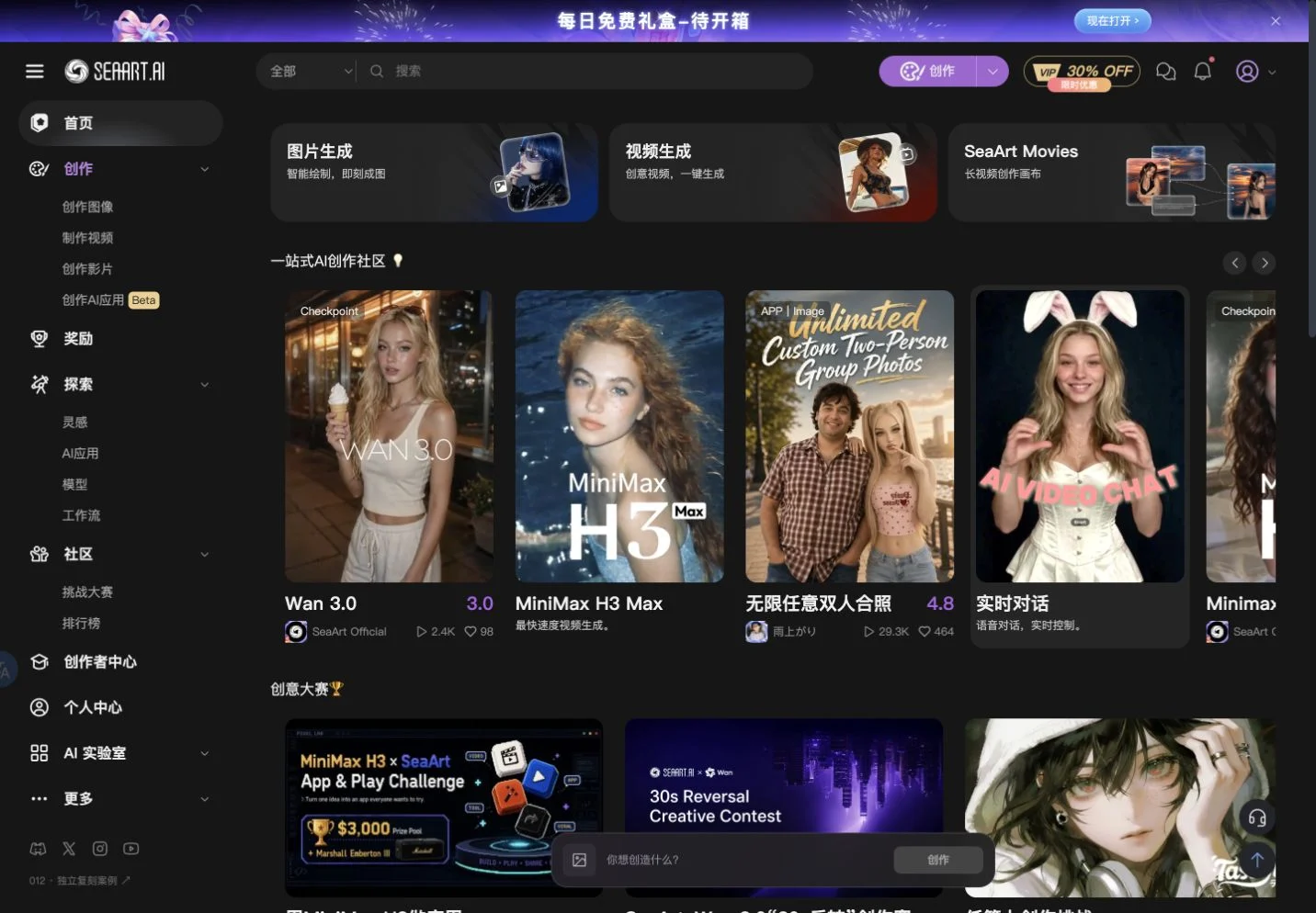 CHINESE HOMEPAGE · CASE 012OPEN REPLICA ↗
PRODUCT MODEL
WHY IT EXISTSReconstruct the homepage's navigation, content density, media hierarchy, and creation entry points as a focused interface study.
A Chinese frontend specimen and an English case that explain how discovery and creation share one workspace.Place the main creation modes near the top so a visitor can act before browsing the community.
Use distinct horizontal rows to introduce tools, visual styles, and timely community activities.
Let artwork lead while keeping categories, titles, and navigation readable at a higher content density.
Provide a consistent creation entry so browsing does not require navigating back to the top.
STYLE DNA
VISUAL + BEHAVIORAL RULESThe dark sidebar gives a changing visual feed a consistent frame. Grouping and selection make the dense interface easier to scan.
Near-black surfaces recede behind vivid imagery. White headings and quieter metadata preserve a readable hierarchy around the work.
Creation choices, recommended models, events, and artwork use different card rhythms, so the page remains navigable as content grows.
Model recommendations use tall portrait cards; events use landscape artwork; the community feed returns to portrait cards. One universal crop would erase that distinction.
The first creation choices and the persistent creation entry serve the same action at two different moments in the browsing session.
Temporarily hide the artwork. Check whether navigation, section labels, card spacing, and primary actions still explain where to go.
SOURCE & PROMPT
ORIGINAL + DISTILLEDThe source brief asks for a close SeaArt reproduction. The reusable prompt describes the interface decisions for a separate creative product with an original identity.
The prompt records the study's intended interface rules. It has not been validated by generating a separate implementation without access to this specimen.
The browser-visible Chinese creator-community homepage is the reference state. Its visual structure and local frontend behavior define the study's scope.
OWNER REQUEST — 2026-09-08
Reproduce the homepage at https://www.seaart.ai/zhCN as closely as possible and deploy it as a new case in the project.

REFERENCE STATE
Chinese creator-community homepage observed in the browser.
- Dark persistent navigation and compact page header
- Three creation entry points
- Horizontal model recommendations
- Competitions and community artwork
- A creation action available while browsing

STUDY BOUNDARY
Reproduce the visible homepage and its local frontend interactions.
The specimen uses Chinese interface copy; the collection analysis uses English.
Keep source attribution on the case page and record localized asset provenance.
Do not connect SeaArt account, payment, upload, or generation services.
Source product statements are preserved reference copy, not independently verified claims.Written after the working product was built, then organized into goal, visual language, layout, interaction, motion, accessibility, use cases, and limits.
Build a responsive creator-community homepage for an original AI creative product, using your own brand, copy, and licensed assets.

Product goal: help a creator choose a creation mode, discover useful models, explore community work, and return to creation without losing their place.
Composition: anchor the desktop page with a persistent left navigation rail. Place a compact header above the main content. Begin with three creation entry points, then horizontal recommendation cards, a competition or event area, and a visual community feed. Keep a creation action available during browsing.
Visual language: use near-black page and navigation surfaces, a small number of slightly lighter panels, restrained borders, clear white headings, and quieter gray metadata. Let images carry most of the color. Reserve the brightest accent for selection and creation actions.
Typography and density: use a readable interface sans with a complete Chinese character fallback. Separate section headings, card titles, and metadata through size, weight, and spacing. Keep navigation labels stable and text on imagery legible.
Media: preserve the intended crop and aspect ratio for each card family. Use portrait cards for model recommendations, landscape cards for events, and portrait imagery in the community feed. Serve assets locally, give images meaningful alternatives, and defer below-fold loading.
Interaction: implement navigation selection, horizontal card browsing, feed categories, search, and a persistent creation entry. Give each visible action a real destination or clear local feedback. Demonstration flows must explain their frontend scope before asking for input; do not collect account credentials or pretend to generate content.
Responsive behavior: adapt the navigation rail and card density as space narrows. Keep key actions reachable, allow only deliberate row scrolling, and avoid horizontal page overflow. Test desktop, tablet, and narrow mobile layouts against the chosen reference state.
Accessibility and motion: preserve heading order, keyboard operation, visible focus, meaningful control labels, and reduced-motion behavior. Do not use autoplaying movement to hide loading or inactive controls.
Use cases: visual creation tools, model discovery, creative communities, and image-led libraries with frequent browsing.
Delivery: isolate the specimen from the collection shell; document source state, asset provenance, working interactions, and actual verification results. Keep visual fidelity, backend capability, and deployment status separate.
Avoid: bright decoration on every panel, identical card proportions for every content type, unreadable text over artwork, navigation that scrolls away unexpectedly, fake generation results, copied product claims presented as verified facts, and claims of pixel equality without measurements.The Chinese community layout, imagery, content grouping, and action placement guide the specimen. Other account or regional states may differ.
The specimen is packaged separately from the collection, with local interaction behavior and no connection to SeaArt's account or generation services.
The prompt carries navigation, card rhythm, media hierarchy, and persistent actions into an exercise for an original product.
WHEN TO USE
FIT + LIMITSEVIDENCE & REUSE
STATUS + PROVENANCESource: seaart.ai/zhCN ↗, observed on 2026-09-08. Independent study. Not affiliated with SeaArt. The reference is one browser-visible Chinese homepage state; its recommendations and community content may change. Source artwork, marks, and product statements remain attributable to their respective owners. Pixel equality and production speed equivalence have not been measured.
REUSE BOUNDARYReuse the navigation structure, content rhythm, media hierarchy, and creation-entry pattern in an original product. Preserve attribution when discussing this specimen. The replica does not provide SeaArt account access, payment, uploads, or AI generation.