Open the notebook
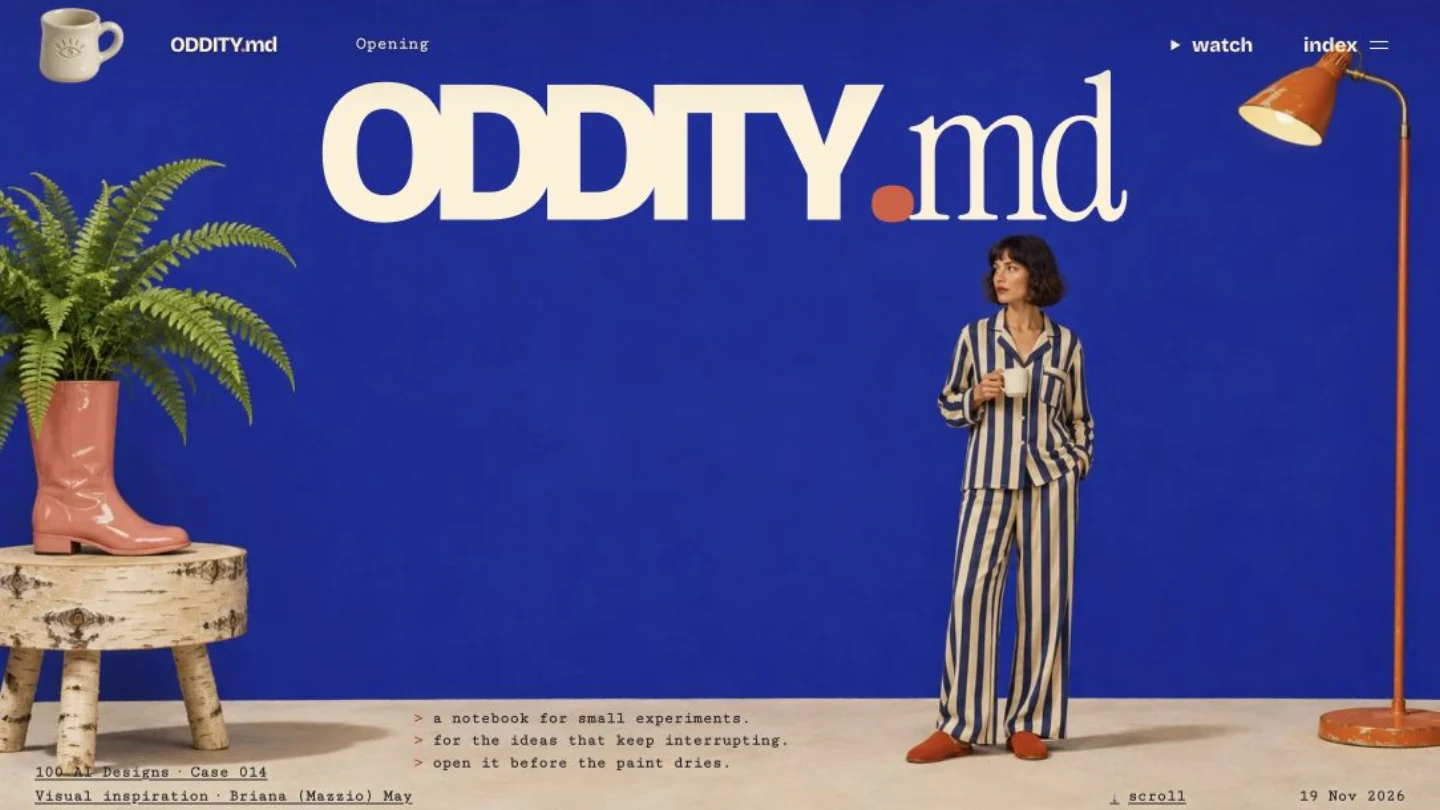
Start in a quiet cobalt studio with the name, a few lines of context and a prompt to scroll.
INTERACTIVE EDITORIAL STUDY
An interactive notebook about making small creative experiments, with scroll-led scenes, hands-free playback, an illustrated index, and a downloadable Markdown edition.
 ODDITY.MD · CASE 014OPEN LIVE EXPERIENCE ↗
PRODUCT MODEL
WHY IT EXISTSGive a small collection of ideas the rhythm of a film and the convenience of an ordinary text file.
Ten creative exercises with illustrated scenes, an index and a Markdown edition.Start in a quiet cobalt studio with the name, a few lines of context and a prompt to scroll.
Progress by scrolling or using the keyboard, or turn on Watch to play the sequence.
Use the illustrated index to return to a scene, open a different entry or switch to the text file.
Read the Markdown edition on the page or download it for your own notes.
STYLE DNA
VISUAL + BEHAVIORAL RULESEvery scene places one prop or figure against a large color field. Leave a quiet part of the frame for the words.
The opening title sits above the set. Small monospaced labels give the journal its file-like rhythm.
The layered cover gives way to a cast revealed inside giant type. Chapters use distinct changes in camera framing and typography to give each idea a second beat.
Painted backdrops and cream photo cards give the reader a visual memory of each stop. A dot marks the current scene.
The original prose also lives in a selectable text view and a Markdown file readers can download and keep.
The journal supports keyboard reading, narrow layouts, and a plain-text entry point when reduced motion is preferred.
SOURCE & PROMPT
ORIGINAL + DISTILLEDHUMAN.md supplied the interaction reference. ODDITY.md uses an original theme, new prose, generated artwork, and an independently written implementation.
This prompt describes the implemented study. Independent reproduction remains untested.
A personal manifesto presented as a sequence of surreal scenes with an illustrated chapter index and a plain-text file.
SOURCE STUDY
Use the whole reading journey as the reference: opening room, scroll-led chapters, Watch, illustrated index, chapter jumps, return to opening, and the downloadable Markdown. Give the adaptation a new topic, write the complete text for that topic, and make the artwork for each of its scenes.Written after the working product was built, then organized into goal, visual language, layout, interaction, motion, accessibility, use cases, and limits.
Create an interactive notebook called ODDITY.md about small experiments in a creative practice.

Write ten grounded entries around actions a visitor can actually try. Give the notebook an introduction, a closing checklist and a final note. Use the same editorial source for the cinematic beats, index labels and full-text Markdown edition.

Stage each beat in a full-bleed room with a saturated wall and open space for the copy. Separate the opening room from the figure so the title, scenery, and actor can move at different speeds. Reveal part of the cast inside oversized type on cobalt, then cut to the same faces rising behind a table on pink. Give chapter copy three beats with time to read each one. Use short, high-contrast lines that stay readable on a phone.

Implement manual scroll and keyboard progression and a separate Watch mode with enough time to read each beat. Keep a compact HUD with a return-to-start control and the current chapter. Let the illustrated index jump directly to every section. Pause playback behind the index and resume when the visitor returns. Add small tactile interactions to selected chapters, including draggable props and a floor that drops a dancing top when activated. Provide a scrollable Markdown reader, a real file download, and a direct plain-text route.

Keep dialogs keyboard operable, restore focus on dismissal and support reduced motion and small screens. Package compressed artwork and font licenses locally. Credit the reference for its interaction design and write and illustrate the new notebook independently.

Use for authored essays, portfolios with a single narrative, and exhibition stories. Avoid hiding the text behind motion, hijacking focus, triggering sound on load, or using real client claims as decoration.The chapter examples move from picking one question to showing a rough draft and keeping the scraps from an experiment.
Generated backdrops and transparent figures let the striped lead change pose. The same four cutouts appear inside the introduction’s letters and at its table.
The same text powers the cinematic experience and the downloadable file.
WHEN TO USE
FIT + LIMITSEVIDENCE & REUSE
STATUS + PROVENANCEIndependent design study. Visual and interaction reference by Briana (Mazzio) May. The notebook text, artwork, and implementation were made for 100 AI Designs. HUMAN.md ↗
REUSE BOUNDARYReuse the prompt, reading controls and layout approach for an essay of your own. Include the accompanying license notices when redistributing the packaged fonts.